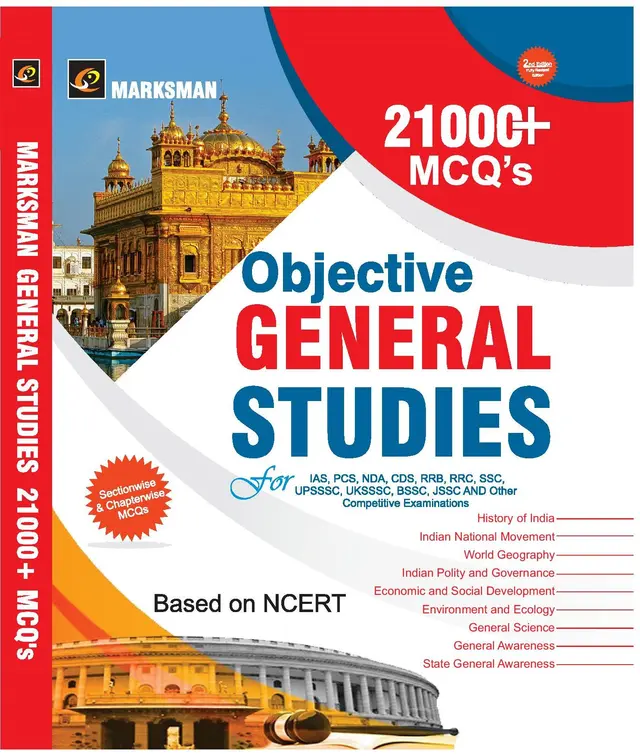
You can use Objective General Studies 21000 MCQ Chapter-wise to structure focused practice across subjects and spot high-yield topics quickly. The book groups thousands of objective questions by chapter and section, helping you match practice to the NCERT-based syllabus and exam trends so you can target weak areas and track improvement.
If you want a concentrated, exam-oriented drill that mirrors past UPSC and State PCS patterns, this compilation gives you a roadmap for sustained, chapter-level practice. Expect chapter-wise MCQs, sectional organization, and updates aligned to recent papers that make systematic revision and rapid self-assessment easier.
Objective General Studies 21000 MCQ Chapter-wise Overview
This chapter-wise compilation organizes 21,000+ objective questions into discrete topics and subtopics, enabling targeted revision and trend analysis. You can track difficulty, chapter coverage, and answer rationales as you move through each subject.
Structure and Format of the Question Bank
The book groups MCQs by chapter and subchapter, so you can focus on a single topic—like Modern Indian History: 1857–1947—or a microtopic such as the Non-Cooperation Movement. Each chapter typically contains:
- A mix of single-best-answer MCQs and assertion-reason items.
- Answer keys with brief explanations or references to NCERT chapters.
- Marks of past-year origin where applicable.
Questions often indicate source exam years (UPSC/State PCS) and are ordered from basic to advanced difficulty. You will find sectional headers, question numbers, and occasional practice sets at chapter ends for timed drills.
Key Subjects Covered in the MCQs
The collection spans core General Studies areas used by UPSC and State PCS exams:
- History (Ancient, Medieval, Modern) with polity and dates.
- Geography (physical, economic, Indian) including maps and climate patterns.
- Polity and Governance covering Constitution articles, landmark judgments, and institutions.
- Economy with budget basics, macro indicators, and schemes.
- Environment and Ecology focusing on biodiversity, conventions, and pollution metrics.
- Science & Technology, General Science, and Current Affairs items tied to recent developments.
Each subject breaks into focused chapters—e.g., Environment → Biodiversity Hotspots, Conservation Acts, International Protocols. You can prioritize weak topics and simulate subject-wise tests using these chapter divisions.
Benefits of Chapter-wise Practice
Practicing chapter-wise lets you measure incremental progress and reduce topic overlap during revision. You can:
- Isolate weak subtopics quickly, then retest only those chapters.
- Build retention through spaced repetition; repeat high-error chapters until accuracy improves.
- Map question patterns and frequently asked concepts across past papers.
Chapter-wise layout also streamlines time management. Allocate daily study blocks to specific chapters, convert chapter-end sets into timed quizzes, and log accuracy per chapter to guide remaining preparation.
Best Strategies for Effective Preparation
Focus on chapter-wise mastery, strict time allocation, measurable progress tracking, and a short list of high-yield revision resources. Apply targeted practice, timed sessions, periodic reviews, and resource curation to convert study hours into reliable scores.
Utilizing Chapter-wise Practice for Higher Scores
Work chapter by chapter and treat each as a mini-testable module. Start by reading the chapter summary or NCERT equivalent, then solve 50–200 MCQs from that chapter depending on its weight in exams.
Mark questions as: correct, partial (you knew the concept but erred), or wrong. Review only the partial and wrong items immediately, and add any missed facts to a one-page chapter cheat-sheet.
Schedule a second pass of the same chapter after 3–7 days to reinforce retention. For high-frequency topics (Polity, Modern History, Geography), increase practice volume and incorporate previous-year questions. Use the chapter-wise split to identify weak concepts quickly and prevent random topic hopping.
Time Management Techniques
Assign daily and weekly time blocks to specific chapters and practice types. Example: 90 minutes for new-chapter study (45 min read + 45 min MCQs), 60 minutes for revision and spaced recall, and one 3-hour slot weekly for mixed-topic mock tests.
Use a visible timetable and color-code slots for reading, practice, revision, and mocks.
Apply the Pomodoro method for intense practice: 25 minutes focused MCQs, 5 minutes break; after four cycles, take a 20–30 minute break. For timed tests, simulate exam conditions at least twice monthly to build pacing and endurance. Log time spent per topic to rebalance study hours objectively.
Tracking Performance and Progress
Keep a simple tracking sheet with columns: chapter, questions attempted, accuracy %, common error types, and last revision date. Update it after every practice session so you spot regressions within a week.
Calculate a rolling 7-day accuracy and a 30-day accuracy for each chapter to observe trends, not single-test noise.
Use tags for error types (fact, concept, calculation, careless) and prioritize chapters with high concept or fact errors for immediate review. Export weekly snapshots to see which chapters moved from “weak” to “acceptable” and adjust your timetable accordingly.
Essential Resources for Revision
Limit yourself to a few reliable resources and use each for a clear purpose: primary text (NCERTs or standard GS book) for concepts, a chapter-wise MCQ book (like the 21000 MCQ collection) for volume practice, and a concise current-affairs tracker for recent events.
Keep one dedicated notebook or digital document for “revision notes” that condense each chapter into bullets, dates, and one-line definitions.
Supplement with 10–15 previous-year questions per major subject and 4–6 full prelims mock tests per month in the last three months. Use one trusted solution bank to verify answers and one spaced-revision app or calendar to schedule recurring reviews.


Leave a Reply